Knowledge Base
Technical materials, standards and recommendations for polystyrene concrete industry professionals.
Articles
Technology, recipes, economics, practical cases and polystyrene concrete research.
Regulatory Documents
GOST R 51263-2012, compositions, SDO recommendations and other documents.
Polystyrene concrete is a lightweight concrete with expanded polystyrene granule filler. It combines low thermal conductivity, high strength and durability, and complies with GOST R 51263-2012. It is used in the construction of residential and industrial buildings, partitions, thermal insulation and monolithic structures.
The composition of polystyrene concrete includes cement, water, expanded polystyrene granules and SDO additive (saponified wood resin). Proportions depend on the required density (D150–D600). Mixing is performed in a horizontal forced-action mixer until a uniform consistency is achieved.
Production uses polystyrene pre-expanders (PND), horizontal mixers (MPTS), automatic dosing systems and cutting complexes (MRK). "CST" designs production lines with capacity from 30 to 580 m³ per shift. More details can be found in the articles and equipment catalog.
How to Produce Polystyrene Concrete?
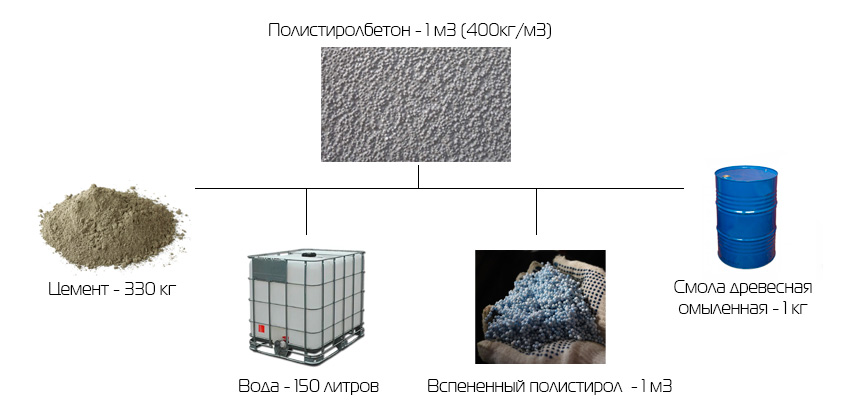
To prepare 1 m³ of polystyrene concrete mixture, mix 150 liters of water, 1 m³ of expanded polystyrene, 330 kg of cement and 1 kg of saponified wood resin in a mixer (for more detailed recipe, see the article "Recommendations for Preparing Polystyrene Concrete Mixture"). Mixing takes about 2-3 minutes (time may vary depending on the mixer characteristics). The finished mixture is poured into various forms or pumped directly to the pouring site (floors, walls, roofs) using a gerotor pump.
Expanded Polystyrene.
The raw polystyrene material is supplied in the form of spherical granules of various diameters. According to GOST R 51263-2012 Polystyrene Concrete, the average granule size must be in the range of 0.7 to 1.6 mm.
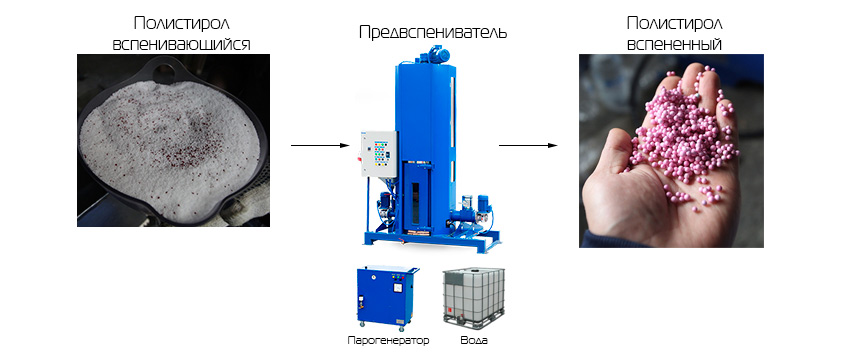
The polystyrene raw material is poured into the receiving hopper of the pre-expander. The pre-expander is connected to a steam generator. Inside the pre-expander, in a steam environment, foaming (expansion) of the polystyrene granules occurs. The density of the raw polystyrene material is about 600 kg/m³; after primary foaming, the density becomes approximately 13-15 kg/m³. The granules are sent to storage silos, where they stabilize and dry over 4-8 hours. After this, to reduce density to 8-12 kg/m³, they are sent for secondary foaming.
Why foam twice? Suppose 1 kg of raw material costs 100 rubles. Then the cost of polystyrene in 1 m³ of polystyrene concrete at a density of 15 kg/m³ will be 1,500 rubles. And at 10 kg/m³, it is already 1,000 rubles.
Have questions?
Contact us — our specialists will advise on technology, select equipment and prepare a commercial offer for your needs.
Contact us →